
NEWS
2026-06-30
Collision risks in construction machinery operations mainly arise from the operator’s inability to obtain complete environmental awareness around the vehicle during operation.
● Large equipment size creates natural blind spots around all sides of the machine
● Excavator slewing and loading operations make side and rear areas difficult to observe directly
● Dump truck reversing and loading alignment significantly restrict rear visibility
● Mixed human-vehicle environments in construction sites increase interaction risks
● Multi-machine coordination has become common, further increasing collision probability
● Nighttime operation, dust, and strong lighting conditions further reduce visibility
Therefore, the core safety challenge in construction machinery is the inability to fully perceive the surrounding environment.
Safety risks in construction machinery operations are typically concentrated in several high-frequency working scenarios.
● Excavator swing collision accidents
● Loader run-over accidents
● Turning, reversing, and passing collision accidents
● Multi-equipment coordinated operation risks
● Construction accidents under low-light, dusty, or harsh weather conditions
STONKAM heavy equipment 360 vehicle camera system is a multi-camera image fusion-based safety assistance solution designed for construction machinery. It provides continuous 360° surround visual coverage around the vehicle, addressing environmental awareness limitations caused by complex machine structures and restricted visibility.
The system synchronizes and stitches real-time video streams from front, rear, left, and right cameras, generating a unified bird’s-eye panoramic view on the in-vehicle display terminal. Combined with AI object detection, it enables operators not only to see the surrounding environment clearly but also to identify potential risks in advance, improving decision-making and response speed during operations.
For construction machinery, safety is not only about “having cameras,” but also about whether the system can detect risks in complex environments and provide timely warnings.
Compared with traditional solutions, STONKAM 360 vehicle camera system integrates AI recognition capabilities, enabling safety assistance for excavators, loaders, cranes, and other heavy-duty equipment.
● Excavator loading operations
STONKAM system overlays AI detection on a 360° panoramic view, displaying both dump truck positioning and personnel within the working zone, helping operators assess bucket operation distance and potential risks.
● Dump truck unloading operations
While providing continuous rear and side visibility, the system uses AI to detect obstacles and pedestrians, reducing collision risks caused by blind spots during reversing.
● Loader loading and unloading operations
STONKAM system identifies and marks personnel and vehicles in real time, improving situational awareness in mixed traffic environments and reducing missed visual risks.
● Equipment positioning and waiting operations
A unified panoramic view combined with AI detection results helps operators quickly identify surrounding vehicles and potential hazards, improving safety in close-proximity multi-machine operations.
Different types of construction machinery involve different risk zones. STONKAM system enables synchronized monitoring and alerts through panoramic fusion and AI detection.
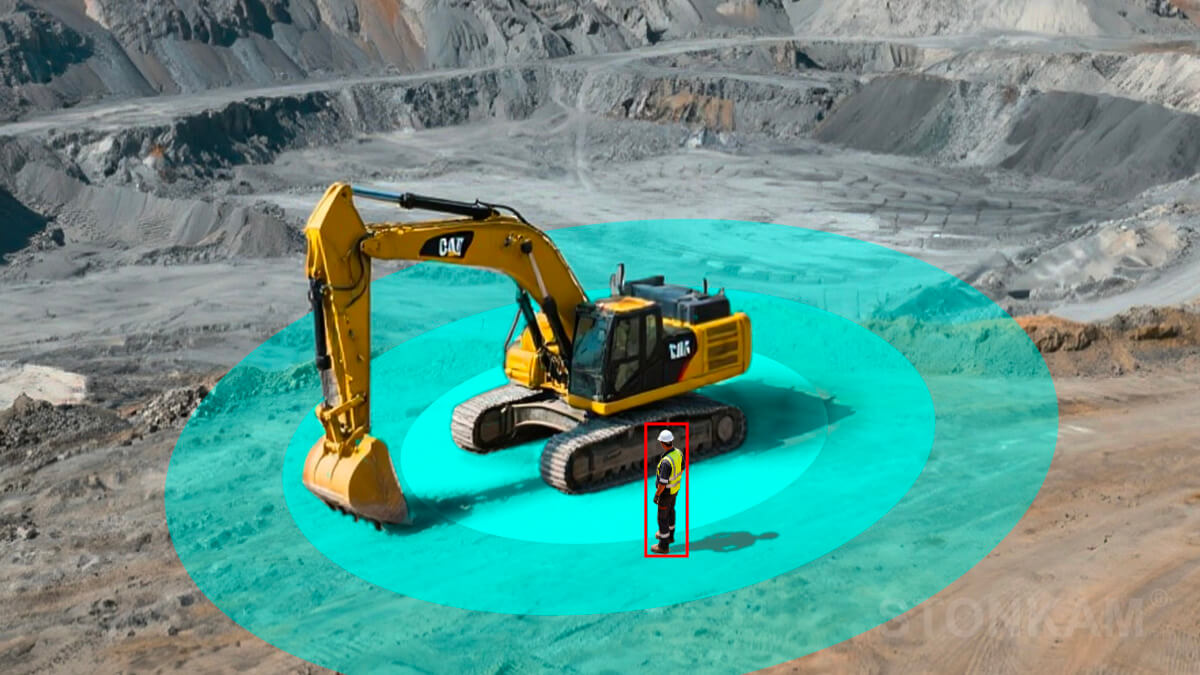
● Swing area monitoring
During excavator rotation, the system detects personnel and obstacles entering the safety radius, improving risk prediction in side and rear zones.
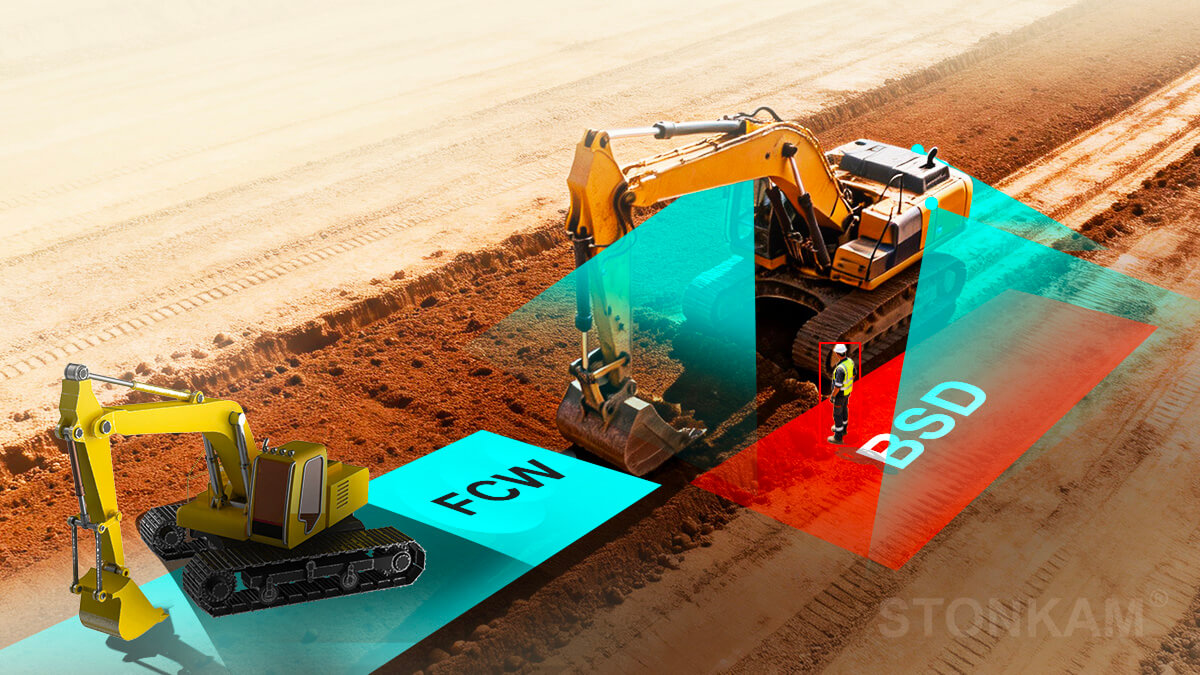
● Vehicle body blind spot monitoring
Integrated FCW (Forward Collision Warning) and dual-side BSD (Blind Spot Detection) provide full-area coverage around the vehicle. The system detects collision risks and identifies objects entering the operating radius in real time.
● Mixed human-vehicle environment monitoring
The system continuously tracks both personnel and vehicles in complex jobsite environments, improving overall situational awareness.
In construction machinery operations, the highest-risk scenarios often occur during loading and material transport, such as excavator-to-dump-truck coordination and loader-to-truck cycle loading operations.
These scenarios involve close vehicle distances, frequent movement, and overlapping blind zones. STONKAM system enhances visibility through multi-camera fusion and real-time environmental rendering, reducing collision risks in coordinated operations.
● 4-channel 1080P video with seamless 360° stitching
Cameras are installed on the front, rear, left, and right of the vehicle. Synchronized capture provides complete environmental data. Image stitching and distortion correction algorithms generate a unified bird’s-eye view of the vehicle surroundings.
● FCW + dual-side BSD detection for early collision warning
The system supports forward collision warning by analyzing distance and relative speed. BSD detects pedestrians and vehicles on both sides, maintaining stable performance in dynamic and low-visibility environments.
● Low-latency real-time video output
Supports RTSP live streaming and low-latency display, ensuring synchronized visual feedback during vehicle movement and steering for improved situational consistency.
What Are the Benefits of STONKAM 360 Vehicle Camera System for Heavy Equipment?
For construction machinery fleets, STONKAM system not only expands driver visibility but also supports safety management and operational efficiency improvement.
● Reduces collision risks caused by blind spots and improves operational safety in complex environments
Real-time surround visibility helps operators detect personnel, vehicles, and obstacles early, reducing accident risks in construction sites and ports.
● Improves jobsite operational efficiency
Operators can reduce frequent stops for environmental checks, enabling smoother reversing, turning, and loading operations.
● Reduces maintenance and downtime losses
Minimizes equipment damage caused by scrapes and collisions, reducing repair costs and downtime.
● Enhances fleet safety management
The system supports video recording and event playback, providing data support for safety analysis and fleet management.
● Earthmoving and excavation equipment: excavators, loaders, graders, drilling machines
● Transport and reversing equipment: dump trucks, semi-trailers, concrete mixers, heavy-duty trucks
● Lifting and hoisting equipment: cranes, port reach stackers
● High-density and heavy-load equipment: road rollers, forklifts
As an early developer of AI-based vehicle safety assistance systems for special-purpose vehicles, STONKAM has been recognized as a “Guangdong Provincial Manufacturing Single Champion Enterprise” in the field of intelligent vehicle safety systems.
For construction fleets, simple visibility is no longer sufficient for modern jobsite safety management. Compared with traditional 360 systems, STONKAM focuses on an integrated approach from environmental perception to active safety.
● 360° surround view + AI detection and warning
Enables real-time detection of pedestrians and vehicles entering risk zones, shifting from visibility to proactive risk prevention.
● 360° surround view + BSD blind spot monitoring
Provides continuous monitoring in high-risk scenarios such as excavator rotation and turning operations.
● 360° surround view + radar fusion
Integrates ultrasonic radar for combined visual and distance sensing, maintaining performance in low-visibility conditions such as night, dust, and fog.
● 360° surround view + remote management
Supports fleet platforms for video storage, remote access, event playback, and safety traceability.
● One-minute calibration + seamless stitching
Simplifies installation with fast calibration and ensures stable panoramic image quality, improving large-scale fleet deployment efficiency.
● RTSP protocol support
Supports RTSP streaming, vehicle display interfaces, and CAN communication for integration with OEM and aftermarket systems.
● Proven project experience
Extensive deployment experience across construction machinery applications enables flexible system configuration for complex jobsite environments such as construction sites and ports.
Compared with traditional 360 surround view systems, STONKAM solution integrates panoramic vision, AI perception, and active warning capabilities, enabling a shift from “seeing” to “understanding and warning,” making it more suitable for modern construction fleet safety management.
Q1:What is the difference between 360 vehicle camera systems and a rear view camera?
A rear view camera only shows the rear area, while 360 vehicle camera systems combine multiple cameras to provide a full surround view, covering front, side, and rear blind zones during operations.
Q2:How long does fleet-wide installation take?
STONKAM supports one-minute auto calibration, which significantly reduces installation and deployment time compared with traditional surround-view systems.
Q3:Is STONKAM 360 vehicle camera system compatible with OEM and aftermarket displays?
Yes. STONKAM 360 Vehicle Camera System supports RTSP streaming, CAN communication, and standard vehicle display interfaces, making it easy to integrate with both OEM in-dash displays and aftermarket monitors.
Q4:How many cameras are required for STONKAM 360 vehicle camera system?
STONKAM 360 camera system uses multiple cameras installed around the vehicle to cover front, rear, and sides. The number depends on vehicle size and required surround coverage.
Q5:Do STONAKM heavy equipment camera systems reduce accidents?
Yes.STONKAM 360 camera system improves visibility during excavating, loading, reversing, and turning. It helps operators see blind spots and detect pedestrians or obstacles, and with AI warnings can alert in real time to help prevent collisions in construction environments.
STONKAM CO., LTD
Add: 1/F.,#6Building,Huangzhou Industrial Park, Chebei Rd.,Tianhe,510660 Guangzhou,China
Tel: (86-20)6667 0988
Fax: (86-20)6667 0977
E-mail: sales@stonkam.com
WhatsApp: +86-15521270579; +86-15708917305

Copyright ©2002-2022 STONKAM CO.,LTD. 广州敏视数码科技有限公司 ALL Rights Reserved. 广东省通信管理局 粤ICP备05043268号





 AI intelligent systems
  AIoT
AIoT  360° Vision Systems
  Intelligent Terminal
  HD Monitors
  AHD Cameras
  Digital Cameras
  CMS
CMS  AI Wireless
  Regulations
  Thermal Cameras
  OEM Solutions
  Industry Applications
 Successful Case
  News
News
 Videos Center
 Introduction
  Why STONKAM®
  Culture
  Milestone
  Certificates
  Contact Us
 Support