
NEWS
2026-06-30
Despite advances in safety systems, blind spot incidents remain common in truck fleet operations, especially in urban delivery and logistics environments.
● Limited Visibility Around Large Trucks
Semi-trailers, tractor units, and long-body trucks create unavoidable blind areas along the front corners, side length, and rear tail—especially near the coupling area where visibility is weakest.
● Complex Urban and Logistics Environments
Drivers operate in congested streets, loading docks, warehouses, and distribution centers shared with pedestrians, cyclists, and vehicles.
● Frequent Maneuvering Operations
Most truck incidents occur during reversing, docking, turning, and yard positioning, where drivers rely heavily on spatial awareness around the full vehicle length.
● Rising Costs and Fleet Safety Requirements
Even minor incidents can lead to repairs, downtime, insurance claims, and delivery delays, while fleets also face increasing safety requirements and expectations for trucks blind spot risk reduction.
STONKAM 360 Truck Camera System is a surround-view solution designed for commercial trucks to provide real-time 360° visibility around the vehicle.
By combining multiple HD cameras installed around the truck, STONKAM system generates a unified bird’s-eye view inside the cabin, helping drivers clearly understand surrounding road conditions during driving and reversing.
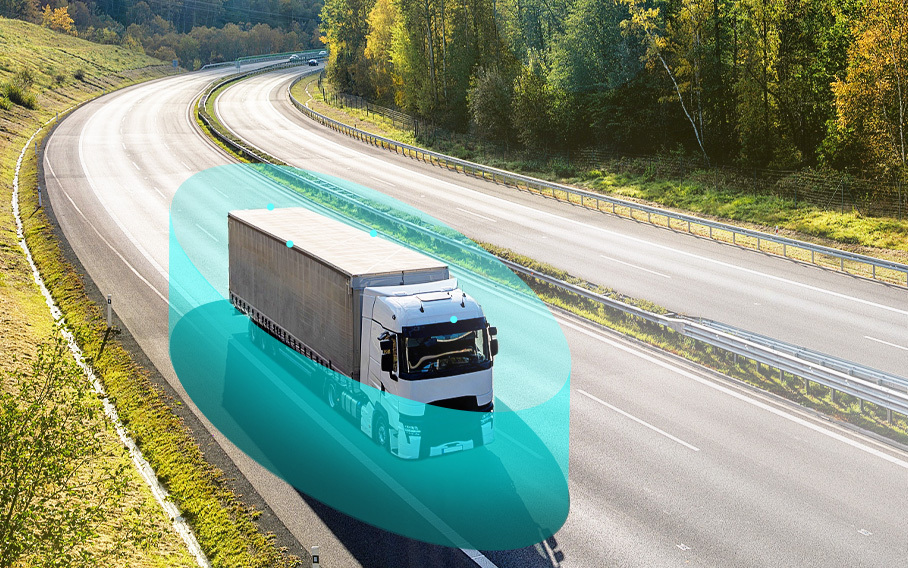
Blind spots are a major cause of truck accidents during turning, reversing in complex driving environments where visibility is limited around the vehicle. STONKAM 360 Truck Camera Systems combine seamless surround-view imaging with AI-powered detection to help drivers improve awareness of potential hazards around the trucks fleet.
● 360° Truck Blind Spot Coverage
Multiple HD cameras cover key truck areas including front, sides, and rear. STONKAM system is designed for long vehicle bodies and trailer structures, providing a real-time 360° view for reversing, turning, and docking operations.
● AI Detection for Truck Blind Spot Risks
Integrated AI BSD and pedestrian detection functions help identify vehicles and pedestrians entering blind spot areas, providing timely alerts to support safer driving decisions.
● Reduced Collision Risks
By combining panoramic visibility with AI alerts, STONKAM helps reduce collision risks during turning, reversing, parking, and operations in logistics yards, loading docks, and urban delivery environments.
In Europe and other global markets, truck safety regulations are increasingly focused on improving vehicle visibility and reducing blind spot risks during trucks operations such as urban driving, reversing, and yard maneuvering.
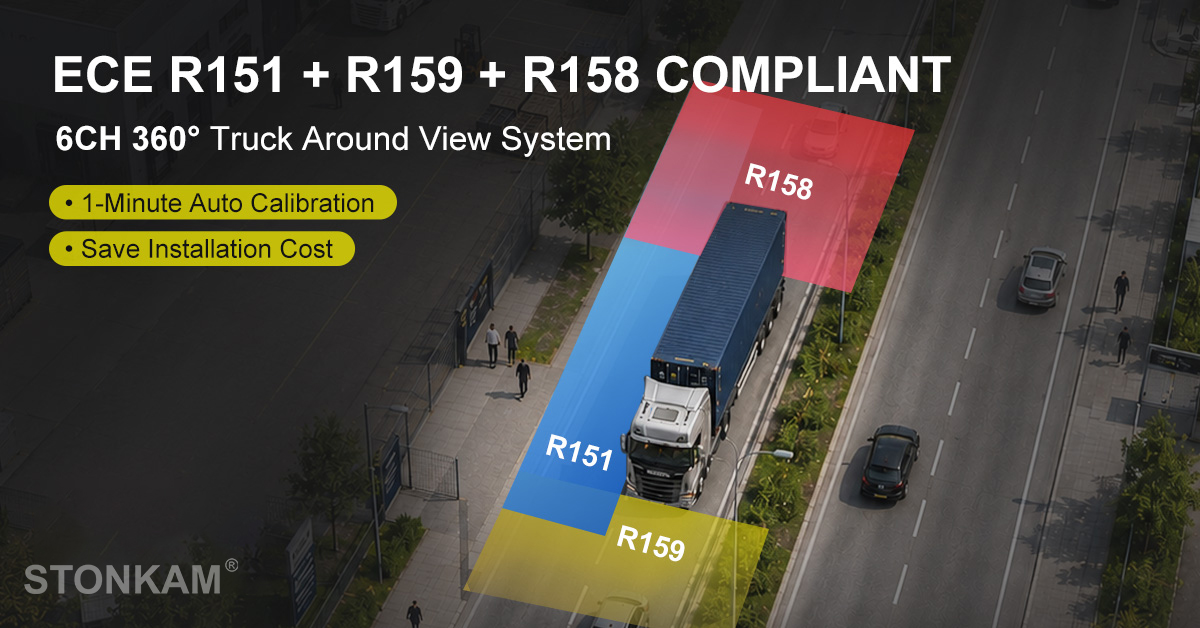
STONKAM 360 Truck Camera Systems help fleets support compliance with key truck safety regulations including UN ECE R151, R158, and R159.
● UN ECE R151
Improves detection of pedestrians and cyclists in side blind zones.
● UN ECE R159
Monitors the forward blind zone to enhance safety.
● UN ECE R158
Monitors the rear blind zone to improve visibility.
These regulations are becoming increasingly important for fleet approval, urban access, and long-term operational compliance.
For fleet operators, installation efficiency is a key factor affecting total deployment cost and fleet downtime.
Traditional surround-view systems often require time-consuming manual calibration and complex installation procedures. STONKAM addresses this challenge through One-Minute Auto Calibration technology.
● Fast calibration and simplified truck installation
STONKAM system completes 360° calibration in about one minute via touch screen or remote control. Only six calibration mats are required, and they can be placed flexibly in fleet yards or logistics depots, significantly reducing installation complexity.
● Faster fleet-wide deployment
Suitable for logistics trucks, semi-trailers, and urban delivery fleets, enabling faster multi-vehicle rollout and standardized installation across different truck types.
● Reduced vehicle downtime
Shorter calibration and installation cycles help trucks return to operation faster, minimizing productivity loss during safety system upgrades.
STONKAM 360 systems are widely applied across multiple commercial transport scenarios:
● Urban delivery trucks (high pedestrian and cyclist interaction)
● Logistics and distribution trucks (frequent loading dock and warehouse operations)
● Semi-trucks and tractor-trailers (extended side and rear blind zones)
● Regional and long-haul transport fleets (daily highway and terminal operations)
● Multi-vehicle fleet operations (standardized deployment and fleet-wide safety upgrades)
● Frequent trucks blind spot-related incidents
● Rising accident repair costs
● Increasing insurance claims
● Urban delivery expansion
● Reversing accident risks
● Fleet safety upgrade projects
● Compliance-driven safety initiatives
For fleets seeking to improve visibility, reduce collision risks, and simplify large-scale deployment, STONKAM 360 Truck Camera System provides a practical and scalable solution for modern truck operations.
Backed by extensive experience in global truck safety projects, STONKAM provides proven 360 camera solutions that help fleets improve visibility, safety, and operational efficiency. View our Global Truck Deployment Projects for real-world application examples.
Q1: What is STONKAM 360 truck blind spot camera system for trucks used for?
It provides 360° surround visibility for trucks across all driving environments, helping improve situational awareness on highways, in urban traffic, and in complex operational areas such as logistics sites and industrial zones.
Q2:How do fleet operators choose the truck blind spot camera system?
Look for a solution with complete blind spot coverage, AI detection, UN ECE compliance, HD imaging, and easy integration. STONKAM delivers all these capabilities in one reliable system, helping fleets improve safety while reducing deployment and maintenance effort.
Q3:What is the difference between 360 vehicle camera systems and a rear view camera?
A rear view camera only shows the rear area, while STONKAM 360 vehicle camera system combines multiple cameras to provide a full surround view, covering front, side, and rear blind zones during truck operations.
Q4:How can STONKAM truck blind spot camera systems help prevent pedestrian collisions?
STONKAM systems use AI pedestrian recognition to identify risks in real time. With multi-camera coverage and built-in processing, the system detects pedestrians entering blind spots and triggers instant audio-visual alerts to help drivers avoid collisions.
Q5:Can STONKAM truck blind spot camera system be integrated with AI and radar sensors?
Yes. STONKAM system can work with AI detection algorithms and ultrasonic radar to provide visual monitoring, distance measurement, and collision warning functions.
STONKAM CO., LTD
Add: 1/F.,#6Building,Huangzhou Industrial Park, Chebei Rd.,Tianhe,510660 Guangzhou,China
Tel: (86-20)6667 0988
Fax: (86-20)6667 0977
E-mail: sales@stonkam.com
WhatsApp: +86-15521270579; +86-15708917305

Copyright ©2002-2022 STONKAM CO.,LTD. 广州敏视数码科技有限公司 ALL Rights Reserved. 广东省通信管理局 粤ICP备05043268号





 AI intelligent systems
  AIoT
AIoT  360° Vision Systems
  Intelligent Terminal
  HD Monitors
  AHD Cameras
  Digital Cameras
  CMS
CMS  AI Wireless
  Regulations
  Thermal Cameras
  OEM Solutions
  Industry Applications
 Successful Case
  News
News
 Videos Center
 Introduction
  Why STONKAM®
  Culture
  Milestone
  Certificates
  Contact Us
 Support