How to Configure an AI MDVR for City Bus Monitoring
What Should a City Bus MDVR System Monitor?
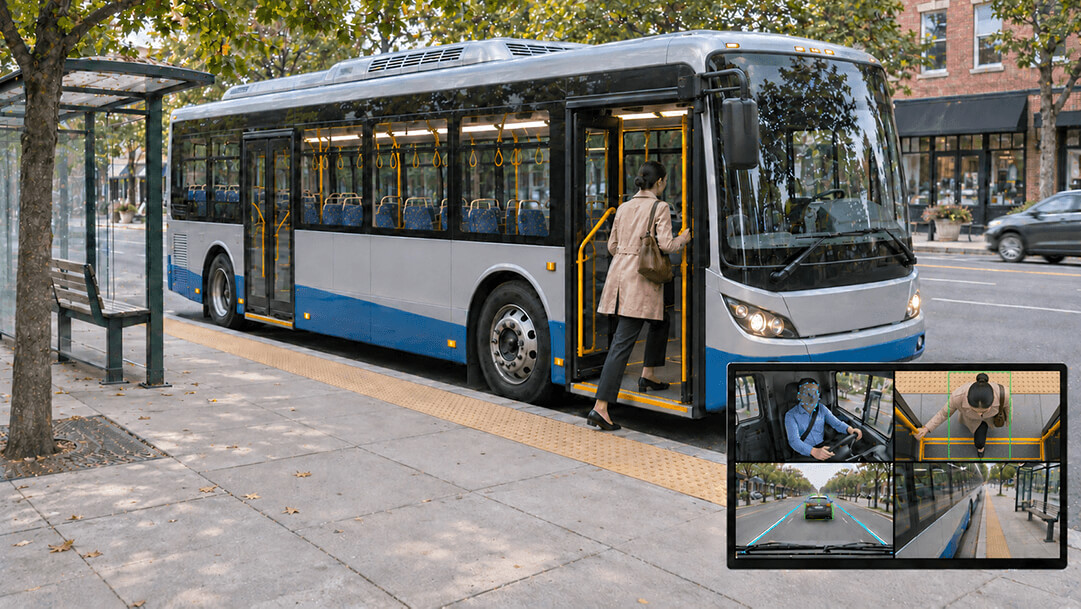
A city bus MDVR system is an onboard video recording and AI monitoring solution that connects cameras to monitor driver behaviour, passenger boarding and alighting, vehicle blind spots and forward driving conditions. An AI MDVR for city buses should match the vehicle layout and operational requirements while supporting video recording and event data transmission to a fleet management platform.
A city bus surveillance system typically focuses on four monitoring areas:
● Driver Monitoring: Monitor driver behaviour and support fatigue and distraction detection.
● Passenger Boarding and Alighting Monitoring: Record passenger movements when boarding and leaving the bus.
● Side Blind‑Spot Monitoring: Use BSD cameras to detect supported objects, such as pedestrians and cyclists, in configured areas alongside the bus.
● Front Road Monitoring: Use forward‑facing cameras to support ADAS functions and identify supported driving risks ahead.
Operators should plan camera positions according to vehicle structure, viewing angles and monitoring priorities. This layout helps determine the required camera inputs and AI function combinations when selecting an AI MDVR.
How Should Cameras Be Positioned on a City Bus?
Camera placement in a bus camera system should reflect the areas operators need to monitor. The final layout depends on bus dimensions, door configuration and camera viewing angles.
|
Monitoring Area |
Suggested Camera Position |
Monitoring Purpose |
|
Driver Area |
Facing the driver |
Monitor driver behaviour and fatigue |
|
Front Entrance |
Above or near the front door |
Record passenger boarding and alighting |
|
Rear Entrance |
Above or near the rear door |
Monitor passenger movement |
|
Passenger Cabin |
Facing the passenger area |
Record passenger activities |
|
Front Exterior |
Facing the road ahead |
Monitor forward driving conditions |
|
Side Exterior |
Covering vehicle sides |
Monitor surrounding traffic |
|
Rear Exterior |
Facing behind the bus |
Record rear traffic and reversing activities |
Not every area requires a separate camera. One camera may cover multiple areas depending on its position and viewing angle. A four‑camera layout may be sufficient for projects with limited monitoring priorities.
STONKAM AI MDVR supports AHD camera inputs, allowing compatible AHD cameras to work with the MDVR's built‑in AI algorithms. Operators should confirm camera positions and input requirements on the actual vehicle before selecting an MDVR.
How Many Video Channels Does a City Bus Need?
The required MDVR channel configuration depends on the bus monitoring layout and the customer's preferred AI functions. STONKAM offers 4CH, 6CH and 8CH AI MDVR solutions for different city bus monitoring requirements. These models support different AHD and IPC camera input configurations and multiple AI algorithms, allowing customers to select suitable camera connections and AI function combinations for their applications.
|
MDVR Configuration |
STONKAM Models |
AHD Camera Inputs |
IP Camera Expansion |
AI Function Combinations |
|
4CH |
4 |
Up to 4 IP cameras per model |
BSD; ADAS + BSD; 360 + ADAS; DMS + BSD;BSD+APC |
|
|
6CH |
6 |
Not supported |
ADAS + DMS + BSD + 360; BSD; 360 |
|
|
8CH |
8 |
Up to 4 IP cameras per model |
DMS + ADAS; 360; BSD |
The 4CH, 6CH and 8CH labels refer to AHD inputs. If the layout also includes IP cameras, check whether the selected model supports IP camera expansion and can record all required feeds simultaneously.
Which AI Functions Should a City Bus MDVR Support?
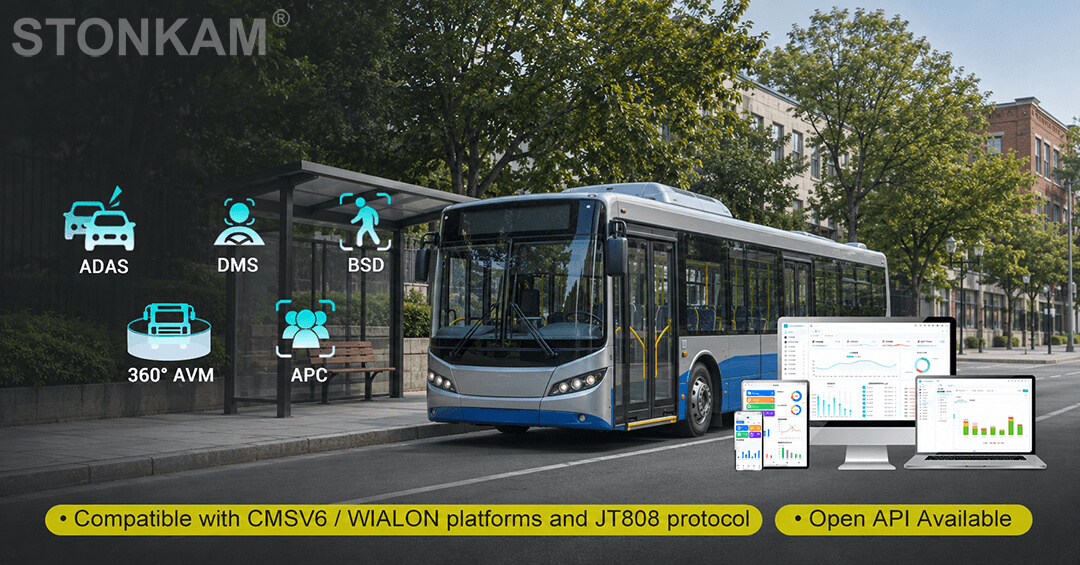
AI functions should address specific operational monitoring requirements. STONKAM AI MDVR supports five functions for city bus applications:
● DMS (Driver Monitoring System): Monitors driver behaviour and supports fatigue and distraction detection.
● BSD (Blind Spot Detection): Detects supported objects, such as pedestrians and cyclists, in configured blind‑spot risk areas.
● ADAS (Advanced Driver Assistance System): Identifies supported forward driving risks.
● AVM (Around View Monitoring): Provides surrounding views to assist low‑speed manoeuvring.
● APC (Automatic Passenger Counting): Supports passenger counting and flow analysis.
All four STONKAM AI MDVR models covered in this guide support DMS, BSD, ADAS, 360° AVM and APC. The functions enabled on a bus depend on its monitoring needs and camera setup. Before deployment, confirm the camera requirements and which functions can run together in the intended configuration.
What Video Recording and Storage Configuration Does a City Bus Need?
A city bus MDVR should support continuous recording and event‑related footage review. STONKAM MDVR solutions support multiple recording modes and 15‑second pre‑recording, capturing footage from before an event is triggered.
H.264/H.265 dual‑format compression helps manage storage requirements and video transmission loads. Storage configurations vary by model:
● DV455: Supports 4 SD cards, up to 256GB each.
● DV456: Supports SD card and SSD storage.
● DV436: Supports 2 SD cards, up to 1TB each.
● DV454: Supports 1 SSD, up to 2TB, and 1 SD card, up to 512GB.
Actual retention time depends on camera count, resolution, frame rate, compression format and recording mode. Operators should calculate the required storage capacity according to the bus camera recording system configuration and video evidence requirements. Network availability and remote video access requirements should also be considered.
How Should a Bus MDVR Connect to the Fleet Management Platform?
A bus fleet management system connects onboard monitoring with centralized vehicle and operational management. It allows operators to monitor vehicle locations, access video and manage supported AI events across the fleet.
STONKAM AI MDVR offers integration options for CMSV6 and Wialon, supports the JT/T 808 protocol and provides an Open API for connecting with customer‑owned or third‑party platforms.
Depending on the platform and configuration, connectivity can support:
● Vehicle Positioning: Monitor vehicle locations and route information.
● Remote Video Access: View live video and access recorded footage.
● AI Event Management: Receive and manage supported AI events, including DMS and BSD events.
● Fleet Administration: Organize vehicle and driver information.
Before deployment, operators should confirm platform versions, protocol settings, required data fields and API compatibility. Testing the integration on a sample vehicle helps identify configuration requirements before fleet‑wide installation.
What Should Operators Test on a Pilot Bus?
● Camera coverage: During a trial run, review footage from each monitored door to confirm that it clearly shows passengers boarding and alighting.
● Event reporting and playback: Trigger a configured alert and check that it appears against the correct bus and that the relevant clip can be retrieved.
● If APC is enabled: compare the system’s boarding and alighting counts with a manual count at each configured door during the trial run
Why Choose STONKAM for City Bus AI MDVR Projects?
With more than 23 years of experience in vehicle electronics, STONKAM provides AI MDVR and integrated video telematics solutions for public transport operators.
● Onboard Monitoring: Multi‑camera coverage supported passenger compartment monitoring and remote video access.
● Event Recording: Multiple trigger‑based recording modes, including G‑sensor, overspeed and alarm inputs, combined with 15‑second pre‑recording, helped preserve critical footage.
● Local Server Integration: The system was integrated with the project partner's self‑hosted server and customized platform.
● Centralized Management: Remote access to live video, playback, GPS information, alarm records and device status supported fleet monitoring and maintenance.
This project demonstrates STONKAM's experience in bus surveillance deployment, customized platform integration and remote fleet management.
Conclusion
STONKAM provides AI MDVR solutions for city buses, supporting different AHD camera input configurations, AI function combinations and public transport fleet management requirements.
When configuring a system, operators should first identify the required monitoring areas and camera positions, then select an MDVR with suitable AHD camera inputs and, where required, IPC interfaces. They should also determine the required AI function combinations, verify storage capacity and confirm fleet platform compatibility before deployment.
By matching camera input configurations and AI functions to actual vehicle layouts and customer requirements, operators can build a bus surveillance system that supports onboard monitoring and centralized fleet management.
-
There is no fixed camera count for every city bus. The required number depends on bus dimensions, door positions, viewing angles and monitoring priorities. STONKAM offers MDVR models with 4, 6 or 8 AHD camera inputs to accommodate different monitoring layouts.
-
Yes. A STONKAM AI MDVR can connect cameras for driver monitoring, passenger boarding and alighting, side blind-spot detection (BSD) and forward driving assistance (ADAS). The required camera layout and AI function combination can be configured according to the bus monitoring requirements.
-
STONKAM AI MDVR supports DMS for driver fatigue and distraction monitoring, BSD for blind-spot risk detection, ADAS for forward driving risk detection, AVM for surrounding-view monitoring and APC for passenger counting. These functions can be combined according to customer requirements.
-
Yes. STONKAM AI MDVR supports remote live viewing and video playback through compatible platforms such as CMSV6 and Wialon. Network availability and platform compatibility should be confirmed before deployment.
-
STONKAM AI MDVR offers CMSV6 and Wialon integration options, supports JT/T 808 and provides an Open API. Confirm platform versions, protocol settings and required API fields before fleet-wide deployment.
-
Retention depends on camera count, resolution, frame rate, compression, recording mode and storage capacity. STONKAM models offer different storage configurations to meet project-specific recording and evidence requirements.