STONKAM Forklift Camera Solutions: Fork Alignment, Blind Spot Visibility, and Cold Storage Operations

Difficulty seeing pallet openings, restricted visibility when handling loads at height, and camera fogging after entering or leaving cold storage are common visibility challenges in forklift operations.
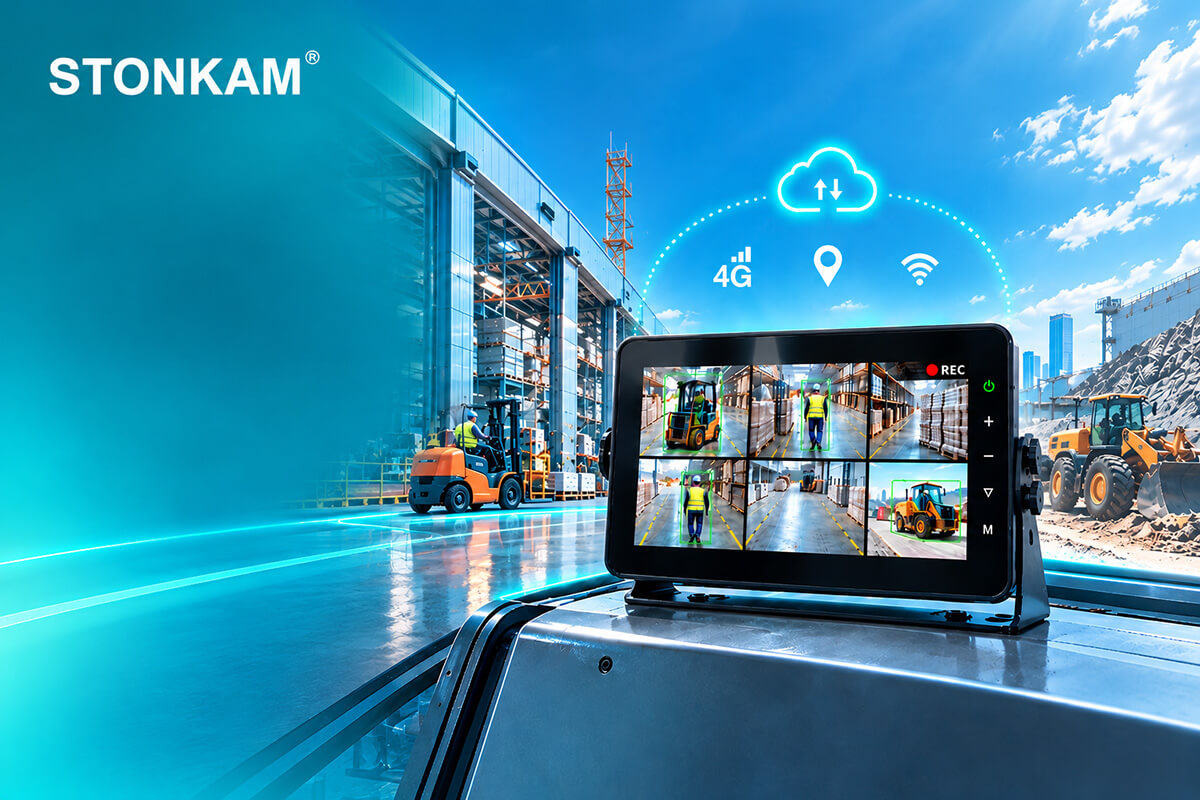
The value of a forklift camera monitoring system lies in bringing real‑time images of critical areas into the operator's field of view. This provides visual reference for fork positioning, load handling, and vehicle surroundings.
STONKAM provides wired and wireless forklift camera systems with compatible in‑vehicle monitors. Depending on the configuration, the solutions can incorporate laser‑assisted positioning and camera heating for defogging and defrosting, supporting forklift blind spot visibility requirements in warehouses, logistics centers, manufacturing facilities, and cold storage environments.
Which Forklift Operating Areas Need Better Camera Visibility?
Different operating conditions require different viewing priorities. Camera placement should be determined by the actual tasks and movements involved.
● Pallet handling and fork insertion: View the relative position of the forks and pallet openings to help operators adjust fork height and direction.
● High‑level stacking and load handling: Provide additional views of the forks, pallets, and elevated loads to help operators assess positioning during loading and unloading.
● Turning and reversing in narrow aisles: Monitor the rear and rear‑side areas where direct visibility is limited.
● Outdoor and port loading operations: Focus on load movement paths, cargo conditions, and critical operating areas based on load dimensions and vehicle structure.
● Cold storage and temperature‑variable environments: Address camera fogging, frost formation, and the effects of low temperatures on equipment and image visibility.
When configuring forklift blind spot cameras, the first step is to identify the areas that need to be visible. Camera viewing angles, mounting positions, video channels, and display methods can then be selected accordingly.
Wired vs. Wireless Forklift Camera Systems: How to Choose?
STONKAM forklift camera monitoring solutions consist of cameras, compatible in‑vehicle monitors, and other equipment as required. Cameras capture images of the forks, rear of the vehicle, or other critical areas and transmit video to the monitor through wired or wireless connections for real‑time viewing.
|
Solution |
Video Transmission and Key Characteristics |
Key Project Considerations |
|
Cameras connect to compatible monitors through cables. Multiple viewing points can be configured as required. |
Confirm cable routing, secure fastening, protection, and routing through moving parts of the mast. |
|
|
Video is transmitted wirelessly, reducing the need for video transmission cables. |
Suitable when cable routing on the forks or mast is restricted and flexible installation is needed. Appropriate power supply and wireless transmission conditions must also be available. |
The main difference between wired and wireless forklift camera systems is their video transmission and deployment method.
Auxiliary functions such as laser positioning, illumination, and heating should be selected according to the specific product model.
For wireless video transmission, camera power supply, mounting and fastening, and on‑site pairing and testing also need to be planned.
Key Capabilities of STONKAM Forklift Camera Systems
● Multi‑area video monitoring: Cameras can be installed on the forks, mast, rear of the vehicle, and other suitable positions according to forklift structure and monitoring needs. Combined with compatible multi‑channel monitors, they provide real‑time views of pallet insertion, load handling, reversing, and turning. Camera placement should account for cargo obstructions and vehicle movements to cover critical operating areas.
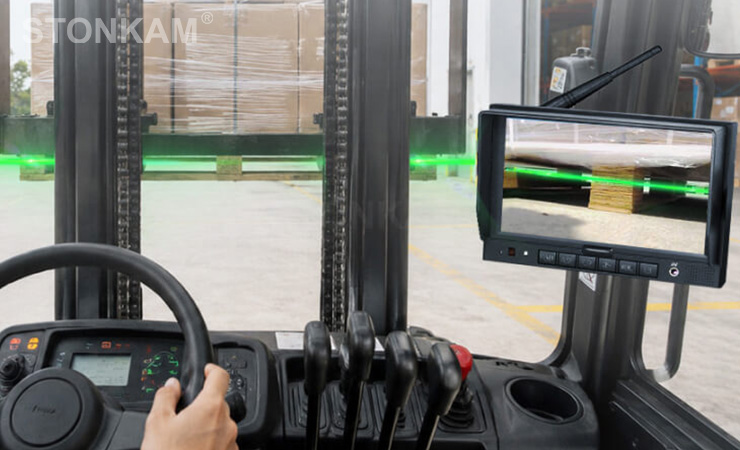
● Laser‑Assisted Positioning for Fork and Pallet Alignment: Selected STONKAM forklift laser cameras feature built‑in laser positioning that projects green guide lines. Combined with real‑time video, these lines help operators judge fork‑to‑pallet alignment and reduce repeated adjustments. Installation should consider fork position, camera viewing angle, and typical operating distance.
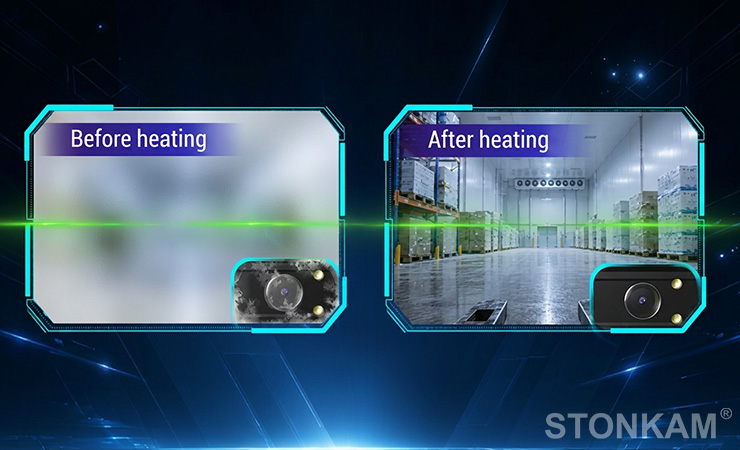
● Camera heating for defogging and defrosting: Selected wireless forklift cameras support heating to address lens fogging and frost in cold storage and temperature‑variable environments. For example, the HDW864 supports automatic heating below ‑10°C and manual timed heating to help maintain image visibility in low‑temperature conditions.
● Flexible installation and environmental adaptation: Selected products feature compact designs, magnetic mounting, and corresponding protection features. Installation can be adapted to forklift structure, mast movement, cargo contact areas, and routine maintenance requirements.
How Should Forklift Cameras Be Configured for Different Operating Conditions?
STONKAM provides wired and wireless forklift video monitoring solutions for different forklift models, installation conditions, and operational requirements.
Configurations can be selected based on the monitoring areas, video transmission method, and special operating requirements.
|
Application Requirement |
STONKAM Solution |
Configuration Considerations |
|
Difficult fork‑to‑pallet alignment |
Forklift cameras with laser‑assisted positioning provide a visual reference for aligning the forks with pallet openings. |
Select the appropriate wired or wireless model and confirm the mounting position and guide‑line performance. |
|
Cold storage operations |
Selected wireless forklift cameras support automatic heating and manual timed heating to help address the effects of fog and frost on image visibility. |
Verify the operating temperature range of the complete system, heating functions, and on‑site image visibility. |
|
Connection to existing video systems or platforms |
Cameras, display terminals, or recording equipment can be selected to match the existing system, depending on project requirements. |
Confirm video interfaces, network protocols, and platform compatibility for the specific models, and validate the connection method. |
By providing multi‑channel video monitoring of critical forklift areas and incorporating functions such as laser‑assisted fork positioning and intelligent camera heating, STONKAM solutions can support different operating conditions, including cold storage and high‑level load handling.
These solutions help forklift operators better observe the surrounding environment and assess the relative position of forks and pallets, supporting operational safety and efficiency.
How Does STONKAM Support Forklift OEM Integration and Retrofit Projects?
For forklift manufacturers, warehouse operators, and system integrators, STONKAM can evaluate equipment configurations and project adaptation requirements based on vehicle structure, monitoring areas, and deployment conditions.
● OEM projects: Evaluate camera positions, monitor installation, and system connections based on the cockpit layout, vehicle power supply, and mast structure.
● Existing forklift retrofits: Select suitable wired or wireless configurations based on existing equipment and wiring conditions, and confirm power supply and mounting arrangements.
● Project‑specific customization: Evaluate customization and adaptation scope based on mounting structures, display terminals, functional configurations, and interface requirements.
For operational video recording and incident review, vehicle recording monitors or recording devices can be included in the configuration.
For automatic pedestrian and vehicle detection with audible and visual alerts, STONKAM AI forklift monitoring solutions can be evaluated separately.
Providing the forklift model, photos of the mast and fork structure, key monitoring areas, operating temperatures, and existing equipment information can help STONKAM assess a suitable forklift camera monitoring configuration more efficiently.
-
It is designed to improve forklift front visibility and fork positioning during material handling. HD wired/wireless video monitoring, laser guidance, and automatic heating help operators work more accurately in demanding industrial environments.
-
The camera features a magnetic housing and supports installation on the forklift fork crossbeam or recessed within the fork arm. It is designed to work with compatible STONKAM wireless display monitors.
-
Compatibility depends on the camera and monitor interfaces and transmission methods. STONKAM can evaluate suitable configurations based on existing vehicle equipment and project requirements.
-
The built-in laser line provides a visual reference for fork alignment, helping operators position forks more accurately, reduce cargo damage, and improve loading and unloading efficiency. STONKAM forklift laser camera can also provide additional visual awareness while turning.
-
Forklift cameras with heating functions help prevent lens fogging and frost. Selected STONKAM wireless cameras support automatic heating below -10°C and manual timed heating for cold storage applications.