STONKAM Forklift Monitoring Solutions: Fork Alignment, Blind Spot Alerts, and Fleet Management
What Are the Main Visibility and Monitoring Challenges in Forklift Operations?
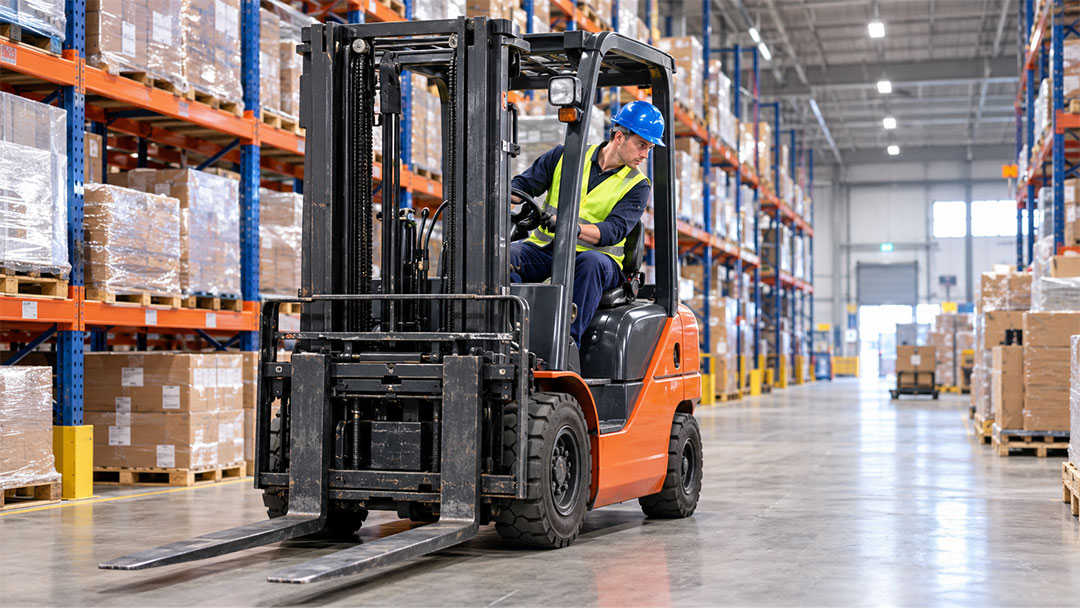
Forklift operators face visibility limitations caused by vehicle structures, loads, and operating environments. Key challenges include:
● Fork and pallet alignment: Forks, the mast, and loads can obstruct the operator’s view, making it harder to guide the forks into the pallet openings.
● Limited visibility in narrow aisles and during reversing: Vehicle structures, loads, and racking can restrict the operator’s view of nearby obstacles and moving objects.
● Blind spot collision risks: Pedestrians, forklifts, and other vehicles often share warehouse and loading areas. Limited visibility during turning and reversing can increase collision risks.
● Multi‑vehicle fleet management: Managers need to monitor vehicle status, operating activities, and abnormal events. Manual inspections and records alone make continuous monitoring, event traceability, and fleet dispatch more difficult.
Forklift onboard monitoring solutions can combine multi‑channel video, AI‑assisted positioning, blind spot alerts, and fleet management to address these challenges.
STONKAM Intelligent Forklift Monitoring Solutions and Key Advantages
STONKAM offers conventional video monitoring and intelligent forklift monitoring solutions for warehousing, cold storage, food storage, and high‑level pallet handling.
|
Solution |
Core Capabilities |
Typical Applications |
Key Benefits |
|
Wired or wireless cameras, multi‑channel video monitoring and display |
Pallet handling, reversing, fork and rear‑view monitoring; difficult wiring or low‑temperature environments |
Extends visibility of key areas; wireless options support flexible installation, laser‑assisted pallet handling, and intelligent heating and defrosting |
|
|
AI pallet recognition, laser positioning assistance, pedestrian and vehicle detection, video recording |
Frequent pallet handling, precise fork positioning, and video traceability |
Assists fork positioning, detects surrounding objects, and records operations for review |
|
|
Panoramic image stitching, AI pedestrian and vehicle detection and alerts, one‑minute automatic calibration |
Narrow aisles, turning, low‑speed maneuvering, and limited surrounding visibility |
Provides a panoramic view around the forklift to help operators observe the surrounding environment |
|
|
AI pedestrian and vehicle detection, ground‑projected warning zones on three sides, and audible and visual alerts |
Warehouse aisles, loading areas, and mixed pedestrian‑vehicle zones |
Helps identify potential collision risks and alerts operators and on‑site personnel |
|
|
Vehicle location and status monitoring, operating records, event traceability, fleet data management |
Warehouses, logistics centers, and ports with multiple forklifts |
Supports vehicle dispatch, centralized monitoring, event investigation, and fleet management efficiency |
1 Conventional Forklift Camera Monitoring Solution
STONKAM conventional forklift camera monitoring solutions use wired or wireless forklift cameras connected to an onboard monitor, providing multiple views of fork operations, loads, and the vehicle surroundings.
● Wired camera monitoring: Cameras installed at different positions transmit footage to the onboard monitor, supporting multi‑angle observation of forks, the rear of the vehicle, and other key areas.
● Wireless camera monitoring solution: STONKAM AI Wireless Forklift Camera supports wireless video transmission and flexible installation. It features laser‑assisted pallet handling and intelligent heating and defrosting, helping operators align pallets and insert forks while improving image visibility in low‑temperature environments.
Key advantages: Flexible deployment, multi‑angle monitoring, laser‑assisted fork operations, and improved visibility in cold environments.
2 Intelligent Forklift Monitoring System Solutions
For frequent forklift operations, mixed pedestrian‑vehicle traffic, and demanding safety management requirements, STONKAM offers intelligent solutions for fork positioning, surrounding visibility, collision risk detection, and fleet management.
2.1 STONKAM Forklift AI Wireless Monitoring System
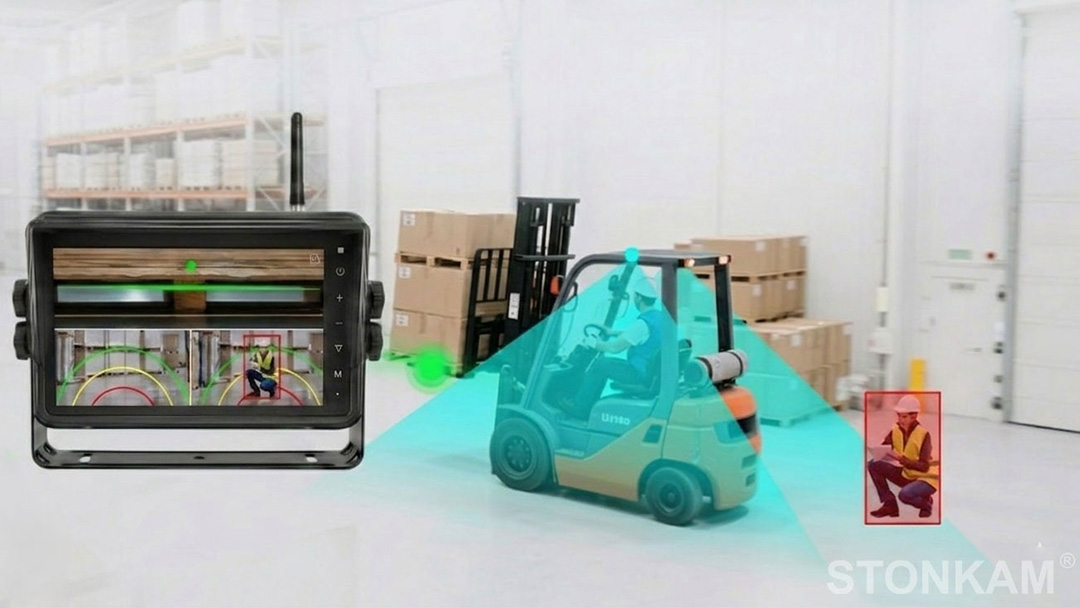
The STONKAM STONKAM Forklift AI Wireless Monitoring System integrates AI algorithms and video recording into an onboard monitor, combined with forklift cameras and other wireless cameras. It brings fork operation assistance, object detection, and video recording into one system.
Core functions:
● AI pallet recognition: Detects pallets as the forks move up and down. Using a configured pallet insertion reference line, it helps operators adjust the relative position of the forks and pallet openings.
● Intelligent laser positioning assistance: Automatically activates the laser when configured fork movements are detected, helping operators determine fork position.
● AI Pedestrian and vehicle detection: Identifies pedestrians and vehicles within configured detection areas to support operational risk awareness.
● Video recording and event traceability: Supports four‑channel loop recording, alarm‑triggered recording, and local playback. A MicroSD storage of up to 128GB can be used to store footage for operational review and event investigation.
Key advantages: Wireless deployment reduces complex wiring. Integrated fork positioning assistance, object detection, and video traceability support frequent pallet handling and demanding positioning requirements.
2.2 Forklift 360 Camera System
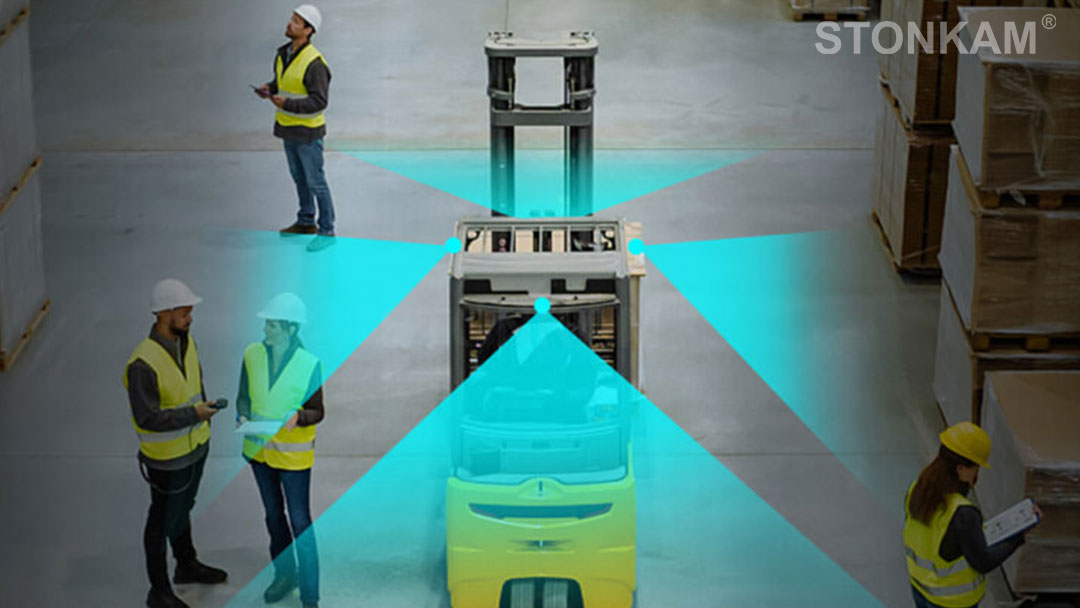
STONKAM Forklift 360 Camera System combines images from multiple cameras to provide a panoramic view around the forklift, helping address visibility limitations during turning, maneuvering in narrow spaces, and operations near the vehicle.
Core functions:
● Seamless panoramic image stitching: High‑precision image processing captures surrounding images in real time, helping reduce visibility limitations caused by vehicle structures and obstructions.
● One‑minute automatic calibration: Supports rapid fleet deployment while reducing manual intervention.
● AI active safety: Detects surrounding pedestrians and vehicles and issues alerts to help operators notice potential risks and take evasive action.
Key advantages: Provides an intuitive panoramic view and combines AI object detection with active collision avoidance warnings. Rapid automatic calibration also supports batch deployment and upgrades.
2.3 Forklift AI Collision Avoidance Warning System
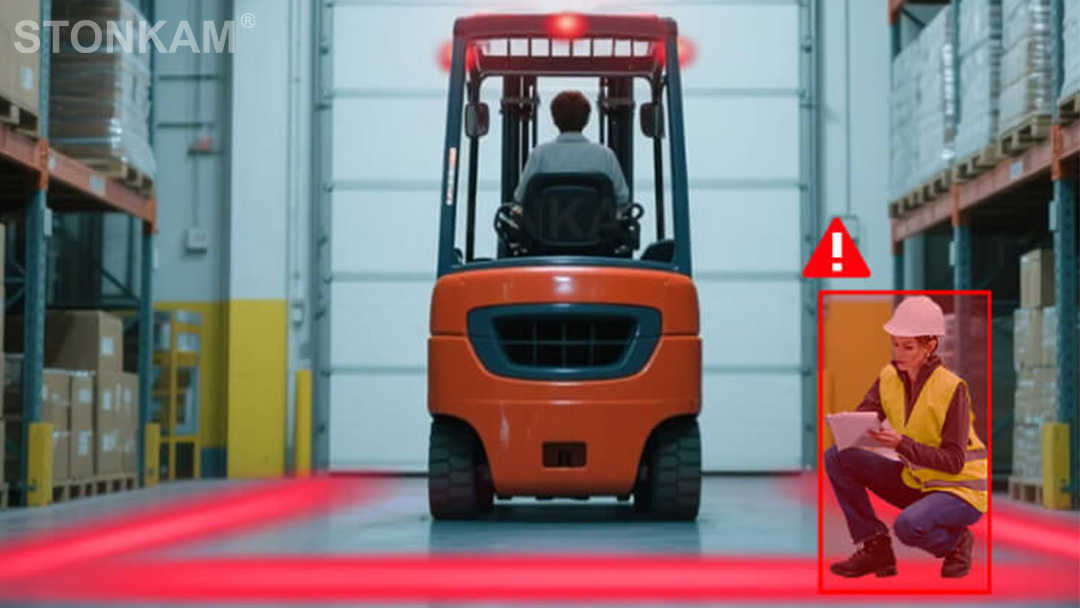
Designed for warehouse aisles, loading areas, and other mixed pedestrian‑vehicle environments, STONKAM Forklift AI Collision Avoidance Warning System combines AI detection,forklift projection warning lights, and audible and visual alerts.
Core functions:
● AI pedestrian and vehicle detection: Identifies objects within configured detection areas and triggers alerts when configured warning conditions are met.
● Forklift Projection warning lights: Projects a visible warning area around the forklift to alert nearby personnel to its operating zone.
● Warning zones and audible and visual alerts: Combines projected warning areas, detection zone calibration, and audible and visual alarms to notify operators and nearby personnel.
Key advantages: Combines object detection, ground warnings, and audible and visual alerts to help improve awareness of potential collision risks in warehouse aisles and loading areas.
2.4 Forklift Fleet Management System
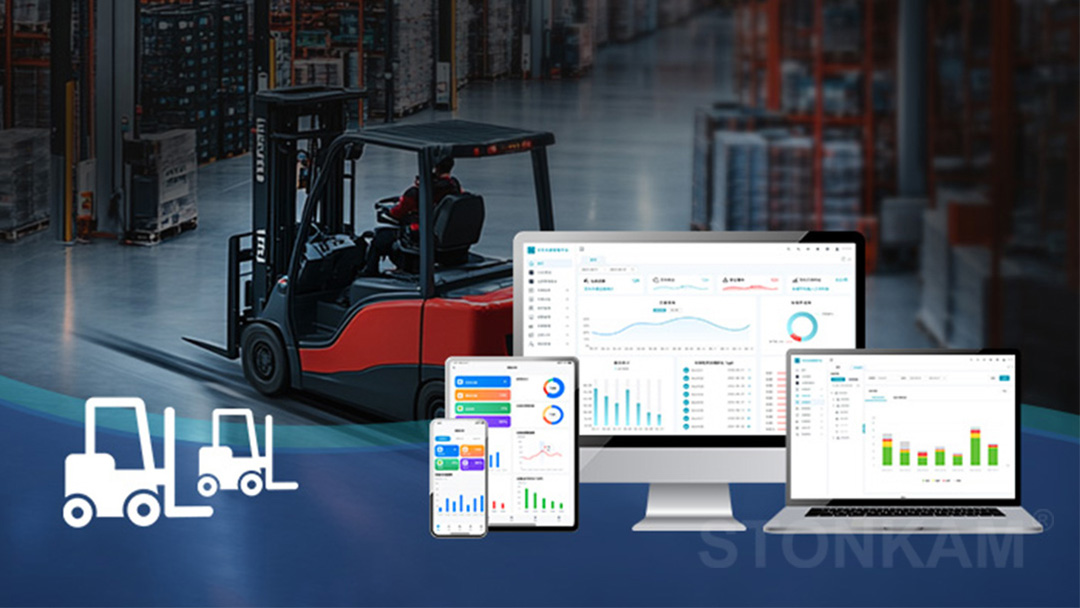
For warehouses, logistics centers, and ports operating multiple forklifts, STONKAM integrates onboard monitoring equipment, positioning and communication hardware, and a management platform.
Core functions:
● Vehicle status monitoring: Tracks vehicle locations, operating status, and related data in real time.
● Operating records and event traceability: Combines onboard video and related data with a cloud‑based fleet management platform to support operational review and event investigation.
● Intelligent driver safety management: Uses facial recognition and identity authentication to verify driver identity and help reduce unauthorized vehicle use. Detects abnormal driver behavior and triggers alerts to support safety management.
● Fleet operational management: Consolidates vehicle and operating data to support dispatch, equipment utilization analysis, and safety management.
● Operational data analysis: Provides insights to help optimize vehicle dispatch and maintenance planning and support continuous improvement.
Key advantages: Extends monitoring from individual forklift operations to fleet‑wide management, helping managers access vehicle status, operating records, and abnormal events for dispatch, investigation, and daily fleet management.
STONKAM solutions range from conventional video monitoring to AI operational assistance, panoramic visibility, collision warnings, and fleet management. They can be deployed individually or evaluated in combination according to project requirements.
How to Configure Forklift Monitoring Systems for Different Operating Environments?
Monitoring configurations should be selected based on forklift type, site layout, operating methods, and environmental conditions.
|
Operating Environment |
Key Monitoring Requirements |
Recommended Configuration |
|
High‑Rack Storage and Retrieval |
Difficult fork‑to‑pallet alignment; mast and loads obstruct visibility |
AI recognition, laser positioning, wireless cameras, and onboard monitor |
|
Narrow aisles and turning |
Limited visibility on both sides, at the rear, and along turning paths |
Multi‑camera monitoring or 360 camera system; evaluate BSD detection where necessary |
|
Loading areas and mixed traffic |
Frequent interaction between pedestrians, forklifts, and other vehicles |
BSD detection, three‑side warning lights, and onboard video monitoring |
|
Ports and heavy‑duty forklifts |
Large vehicles, load obstruction, and higher requirements for viewing angles, image quality, and environmental adaptability |
Cameras, monitors, and multi‑channel configurations selected by installation position and viewing distance; verify protection ratings and wireless capabilities |
|
Cold Storage and Low‑Temperature Operations |
Low temperatures, temperature changes, and potential lens fogging |
Equipment meeting site operating temperature requirements; verify lens anti‑fogging design |
|
Multi‑forklift operations |
Multi‑vehicle video viewing and centralized fleet management |
Onboard monitoring equipment and Forklift Fleet Management System; verify network and compatibility requirements for remote video |
STONKAM provides flexible configurations combining forklift cameras, AI wireless monitoring, AI vehicle monitors, and forklift fleet management platforms to support different warehouse operating environments.
How STONKAM Supports Different Forklift Monitoring Requirements?
For forklift OEMs, equipment suppliers, and fleet operators, solution selection also involves system compatibility, vehicle integration, customization, and project delivery experience.
STONKAM provides forklift and material handling monitoring solutions covering AI operational visibility,active collision avoidance warning, incident video recording,and fleet management.
● Flexible system integration and expansion: Video monitoring, AI detection, 360‑degree panoramic imaging, radar, and fleet management can be evaluated and combined according to project requirements.
● Integration with existing systems: Multiple network protocols are supported. Integration options depend on the specific model, interfaces, and platform compatibility, including remote video viewing and centralized multi‑vehicle management.
● OEM/ODM customization: Camera mounting structures, display terminals, functional modules, and system interfaces can be evaluated for different vehicle types and project requirements.
● Forklift retrofit experience: STONKAM provides solution support based on vehicle applications, operating environments, and customer requirements for forklift safety assistance and fleet visibility management.
Video monitoring alone cannot address every operational requirement. Selecting suitable monitoring and assistance functions for actual working conditions is an important step toward improving forklift visibility and digital management.
By integrating AI cameras, wireless monitoring, intelligent display devices, and AIoT fleet management, STONKAM provides onboard monitoring technology support for forklift manufacturers, warehouse and logistics operators, and fleet managers—helping improve operational safety, fleet efficiency, and warehouse visibility.
-
STONKAM Forklift Monitoring Systems combine AI cameras, wireless vision systems, intelligent displays, and forklift monitoring technologies to improve operator visibility and precision. The solution helps drivers position forks more accurately, reduce blind spots, and handle pallets more safely in busy warehouse environments.
-
STONKAM wireless forklift camera eliminates the need for long video cables running along moving mast sections, reducing cable routing and movement-related installation challenges. It transmits live video to the in-cab display, allowing operators to monitor fork and load movements during lifting and lowering.
-
The system detects pallets and provides visual alignment guidance. During fork movement, preset reference and calibration lines help operators align the forks with the pallet slots, supporting more accurate positioning and reducing repeated adjustments.
-
Yes. STONKAM forklift monitoring systems support retrofitting on existing forklifts. Camera positions, display configurations, and wiring can be adapted to the vehicle structure, installation space, and operational requirements.
-
STONKAM’s 360° camera system combines a stitched surround view with AI pedestrian alerts. Its AI collision warning system focuses on detecting pedestrians and vehicles in configured zones and can combine projected ground markings with audible and visual alerts.
-
STONKAM’s HDW864 combines laser-assisted fork alignment with heated defogging and defrosting. Check the operating temperature ratings of both the camera and display, as well as wireless reception along the intended routes.
-
Yes. With compatible onboard equipment and network connectivity, STONKAM’s forklift fleet management system can centralize vehicle status, video, alerts, and event records. Live viewing and playback depend on the selected hardware and platform configuration.